First Cohort Graduates from UOG’s Library Science Master’s Program
First Cohort Graduates from UOG’s Library Science Master’s Program
First Cohort Graduates from UOG’s Library Science Master’s Program
1/8/2026
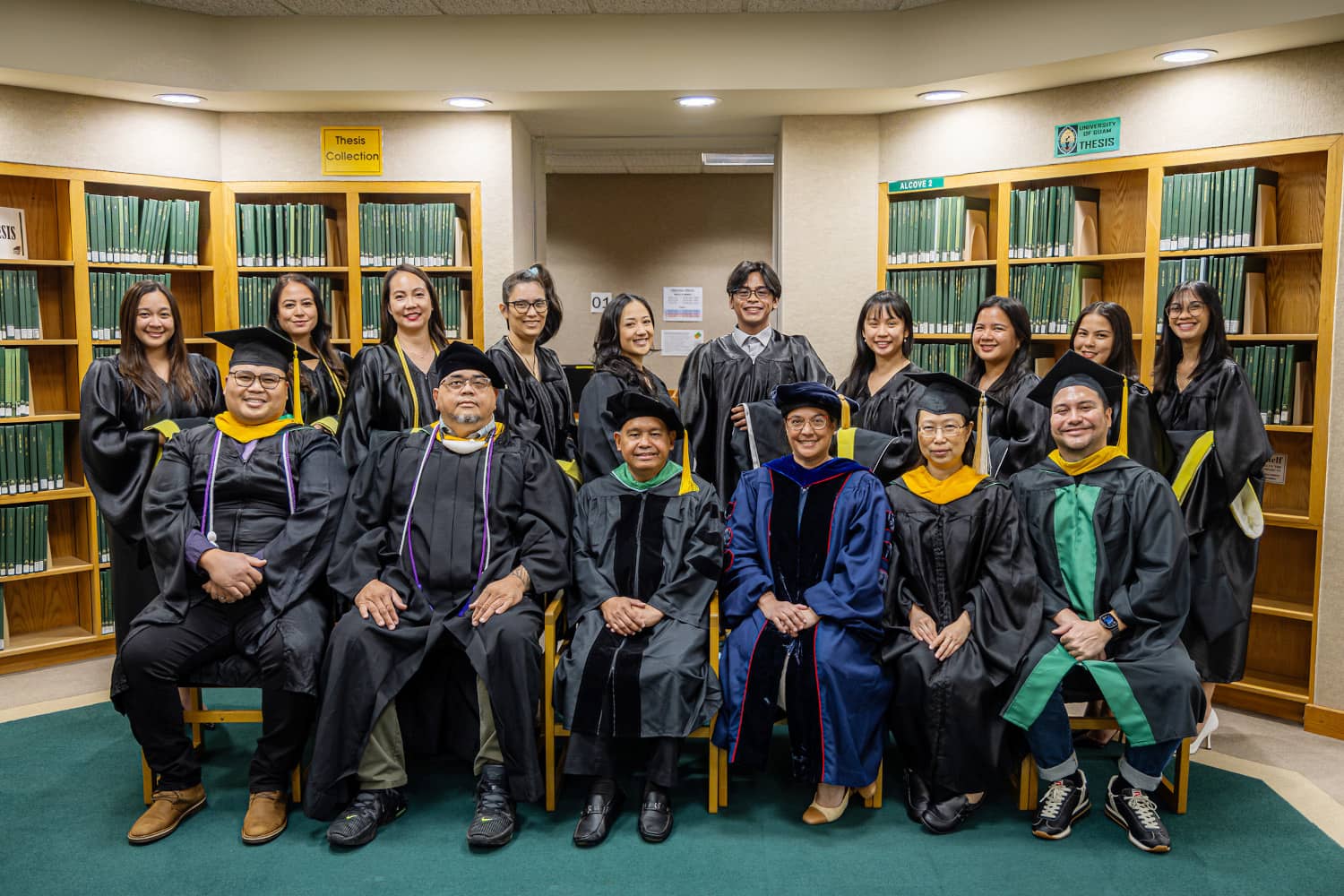

The University of Guam marked a historic milestone at its Fanuchånan (Fall) 2025 commencement ceremony on December 21, graduating its first cohort of 11 students from the Master of Library and Information Science (MLIS) program.
Launched in 2024 through a partnership between the School of Education and University Libraries, the MLIS program was developed to build a regional workforce of professional information specialists and address the evolving demands of the digital age.
“Seeing how technology has forged new grounds for learning and connection, UOG recognized the need to build a workforce of information professionals able to wield global technology to deliver local wisdom,” said Dr. Monique Storie, dean of University Libraries. “Across the region, there is a need to train new library and information resource professionals,” Storie added.
At the time of the program’s launch, a UOG study identified fewer than 30 advanced-degree library professionals serving the 182 libraries and collection institutions across Guam, the Commonwealth of the Northern Mariana Islands, the Republic of Palau, and the Federated States of Micronesia.
Building a Program for the Region
Aligned with American Library Association standards, the MLIS curriculum includes coursework in research methods, archival practices, and information curation, along with internships in professional library settings.
“This inaugural cohort marks the emergence of a new generation of information professionals ready to serve libraries, schools, archives, and cultural organizations,” said Dr. Perry Pangelinan, associate professor and MLIS program chair. “They’ve laid the groundwork for lasting impact, positioning UOG as a leader in information science education across the region.”
For graduate Nicolas Abrenilla, the program provided an opportunity to build on his
experience as an archival specialist at UOG’s Micronesian Area Research Center.
“The program was a journey from start to finish,” Abrenilla said. “It has helped me
elevate myself so that one day I can achieve my dream of working with the heart of
libraries.”
To address region-specific infrastructure and preservation challenges, courses like LS538: Digital Archives and Exhibitions, taught by Professor Ryan Shook, prepared students to digitize fragile analog materials—ranging from manuscripts to oral histories—into durable, remotely accessible collections. In a region where harsh weather and environmental threats constantly endanger physical archives, these skills support sectors such as tourism, public health, education, and historic preservation, and ensure that Pacific history is preserved and shared globally.
Ready to Serve Guam and Micronesia
With the completion of the program, UOG’s MLIS graduates are prepared for professional roles in public, academic, and special libraries, helping to meet critical workforce needs in Guam and Micronesia.
“We are proud of UOG’s first Master of Library and Information Science graduates,” said Storie. “They are pioneers lifting Pacific librarianship — bringing the world to us and our heritage to the world.”
For more information about the Master of Library and Information Science and other graduate degree programs at the University of Guam, contact the Graduate Studies Office at graduatestudies@triton.uog.edu or visit https://www.uog.edu/admissions/graduate-studies.