
UOG Marine Lab alumni sound alarm for endangered staghorn corals
UOG Marine Lab alumni sound alarm for endangered staghorn corals
UOG Marine Lab alumni sound alarm for endangered staghorn corals
2/20/2026
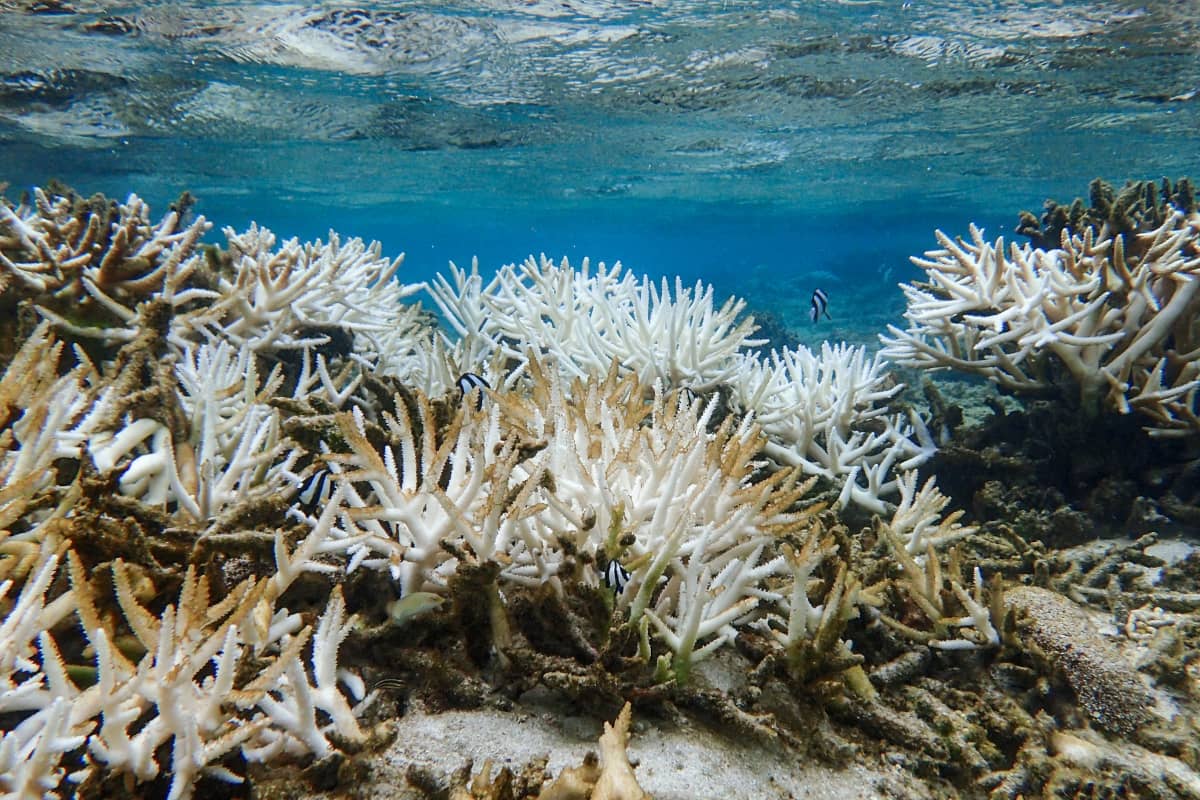
In a letter published in the academic journal Science titled “Endangered Species Act changes threatened reefs,” Colin J. Anthony and colleagues warn of the harm to corals — specifically endangered staghorn corals — following an Executive Order from the White House that prioritizes energy production and national security over coral conservation in Guam waters.
The letter, written by Anthony, Colin Lock, Steven Mana’oakamai Johnson, Shinichiro
Maruyama, and Laurie Raymundo, outlines actions taken by the National Oceanic and
Atmospheric Administration (NOAA) to reverse its initial decision denying the U.S.
Navy’s request to expand the area exempted from Endangered Species Act protections
for shallow-water reefs in Guam that include endangered species.
With protections removed, staghorn Acropora corals in Guam waters face an increased risk of extinction due to warming oceans,
disease, and polluted waters.
Some Acropora corals are listed as Endangered by the International Union for Conservation of Nature
but are not currently listed under the U.S. Endangered Species Act.
Anthony and his colleagues urge the National Oceanic and Atmospheric Administration
to reconsider allowing exemptions to regulations that protect endangered Acropora corals.
Co-author and University of Guam Marine Laboratory Director Laurie Raymundo said, “Staghorn corals create immense three-dimensional
structures on our shallow reef flats; most people who swim in our waters have seen
them. Our reefs here are very diverse, and we must protect that diversity if we want
to continue to protect our shorelines, our fisheries, and our tourism industry. We
lost a great deal of these corals just recently to bleaching, typhoons, and disease,
and we cannot afford to lose any more. We need to protect these communities.”
In 2023, staghorn corals in Florida waters were declared functionally extinct due
to the same threats now facing Guam corals. This means they no longer exist or their
numbers are so severely diminished that they cannot perform their usual function in
the ecosystem.
In Guam, Acropora corals form vast thickets that create essential habitat for fish and other reef species.
Their loss would be a major setback to conservation efforts for reefs in the region.
Three of the five co-authors — Anthony, Lock, and Johnson — are alumni of the University
of Guam Marine Laboratory and have actively participated in coral restoration efforts
in Guam. Anthony and Lock are currently pursuing doctoral degrees focused on corals
at the University of Tokyo and the University of Technology Sydney, respectively.
Johnson is a faculty member at Cornell University, and Maruyama is a faculty member
at the University of Tokyo.