
- Home
-
Admissions
-
Academics
-
Students
-
Research
-
Research Centers
- Cancer Research Center
- Center for Excellence in Development Disabilities Education, Research & Service (CEDDERS)
- Center for Island Sustainability (CIS)
- Marine Laboratory
- Micronesian Area Research Center (MARC)
- UOG Land Grant | agInnovation Research Center
- Water and Environmental Research Institute (WERI)
-
Programs and Departments
- Guam EPSCOR
- Guma' Tinemtom - Micronesia Data Laboratory
- Pacific Islands Climate Adaptation Science Center (PI-CASC)
- Pacific Islands Cohort on Cardiometabolic Health (PICCAH)
- Research Corporation of UOG
- RFK Memorial Library
- UOG Press
- UOG Sea Grant
- University Libraries Digital Team
- NASA Guam Space Grant
- NASA Guam EPSCoR
-
Research Centers
-
Outreach
- Giving
- Alumni
-
About
UOG CIS moves to preserve native cycad species
UOG CIS moves to preserve native cycad species
UOG CIS moves to preserve native cycad species
6/16/2022
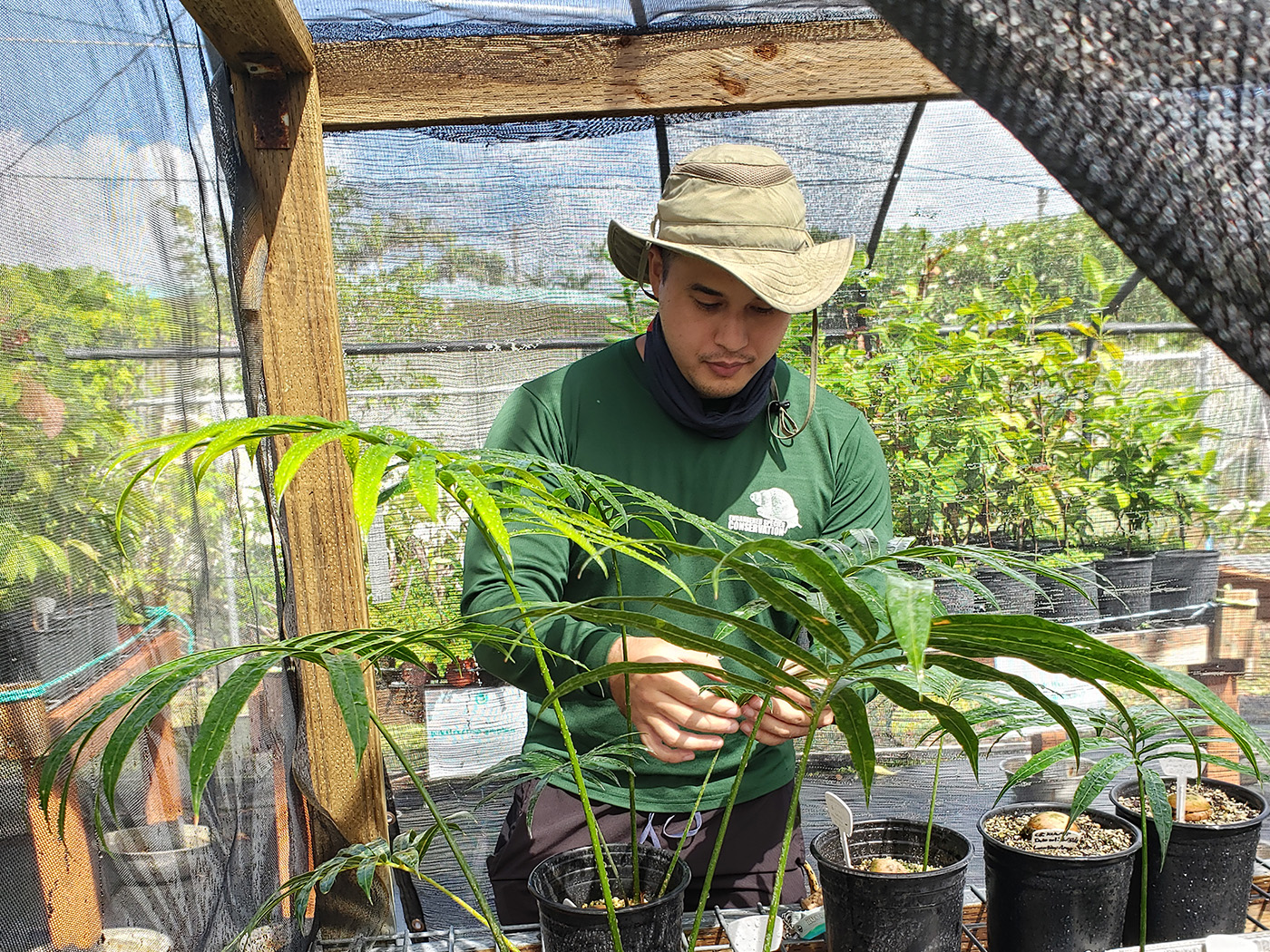
The Center for Island Sustainability (CIS) is focusing on more native species with their plant nursery, collecting seeds from native plants and propagating them.
Guam’s only native cycad, called fadang in CHamoru or Cycas micronesia in science circles, is currently endangered due to an invasive insect, Asian cycad scale, that was accidentally introduced to Guam in 2003. Once the most prolific tree in Guam forests with seeds falling to the ground and sprouting naturally, presently it is difficult to find mature seeds on the female cycad plants due to the ravages of the invasive scale.
“We currently have seedlings collected from fadang plants that have sprouted in our nursery that we will rear and eventually outplant at the Atantano Heritage Preserve in Piti,” explained Dr. Else Demeulenaere, “Ripe seeds have seed coats that are brown and slightly wrinkled and they are getting increasingly rare to find.”
The cycads in the nursery are grown inside a netted “greenhouse” to eliminate the potential of windblown scale insects in the crawler stage infecting the young seedlings.
Kaleb Leon Guerrero is in charge of the nursery, where he carefully monitors for any sign of cycad scale on the seedlings. “We are using environmentally friendly integrated pest management (IPM) procedures to keep the seedlings scale free,” noted Leon Guerrero.
The CIS seed bank becomes increasingly valuable as invasive plants, insects, and animals disturb the natural regeneration of landscapes in Guam.