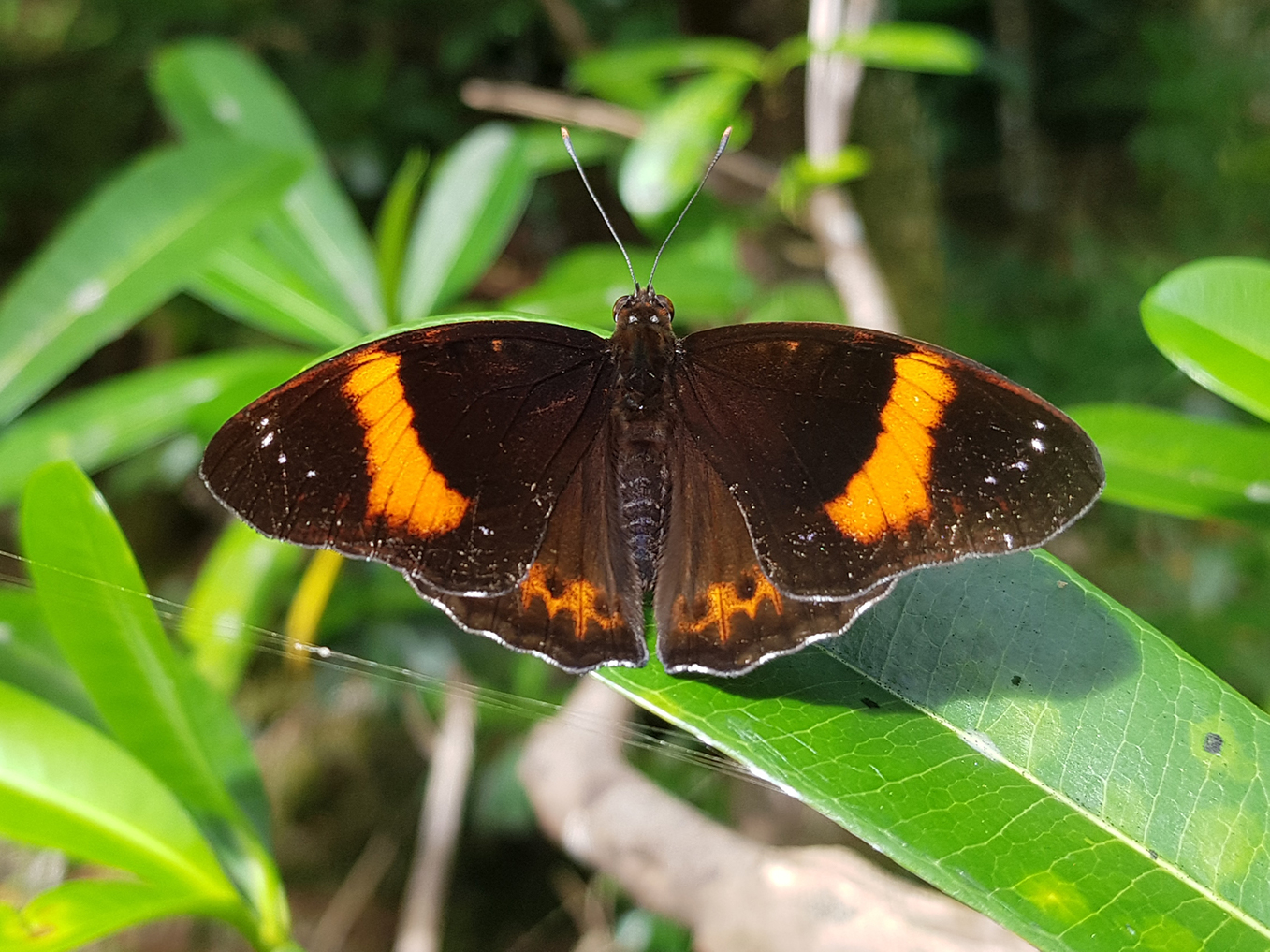
Putnam postured for conservation of endemic, endangered butterfly
Putnam postured for conservation of endemic, endangered butterfly
Putnam postured for conservation of endemic, endangered butterfly
1/29/2022
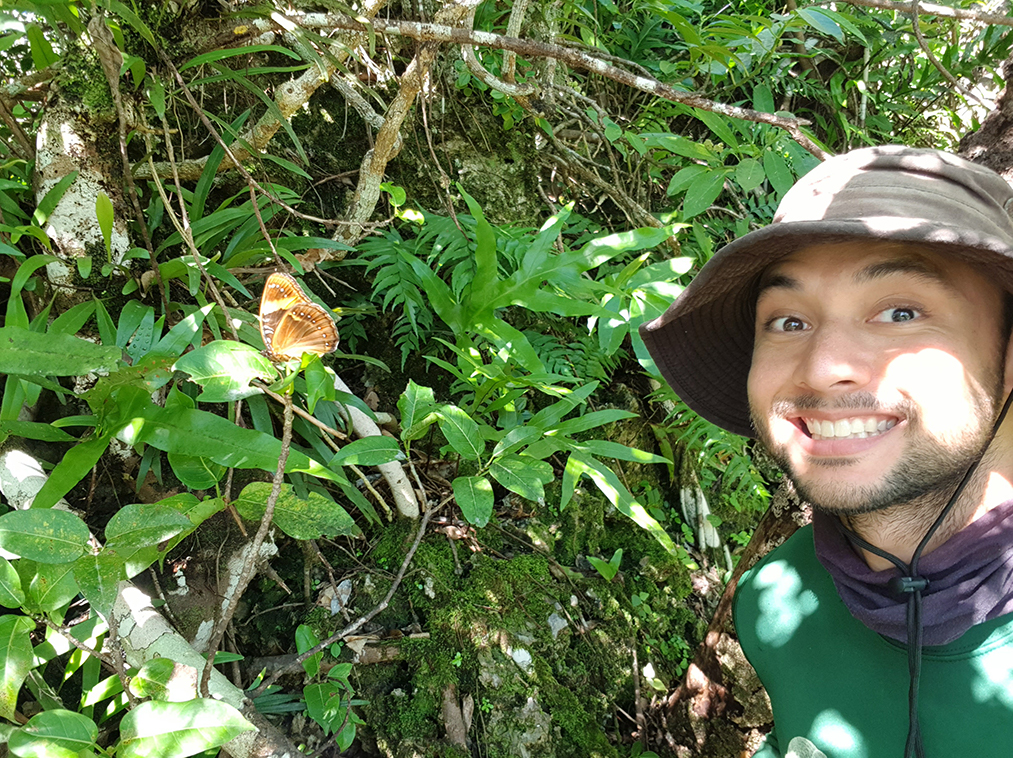
A graduate student and project associate at the University of Guam (UOG) Center for Island Sustainability (CIS) is determined to expand what is currently known about Guam’s only surviving endemic, yet endangered, butterfly species.
Matthew Putnam is about halfway through his year-long monitoring of the Mariana eight-spot butterfly (Hypolimnas octocula marianensis), also known as the Mariana forest flicker or abbabang, as part of what he considers a two-part master’s thesis.
“We definitely know a lot less than what we should know,” Putnam said.
According to Putnam, there are great gaps in the existing knowledge of the species, which he hopes to fill. In addition, the butterflies’ endangered status, with under 20 populations containing anywhere from 20 to 100 butterflies in total, is prompting Putnam to attempt captive breeding at the UOG campus.
Putnam conducts his studies at three main locations throughout Guam’s northern limestone forests.
What he does know is there are fluctuations in the species activity throughout the year, varying with weather conditions and the health of their host plants; that they prefer locations of pristine, undisturbed limestone forest containing their host plants; and that there is a limitation of how far they can travel.
While he hopes to identify more focused areas, like where to encounter the species, efficient survey times, population peaks, and active seasons, Putnam is eager to reach conclusions that can be drawn from successful breeding, such as the length of time between their growth stages, survival rates, and mating patterns.
“I think, through the rearing process, we’d be able to answer a lot of these questions that no one really has any other way of finding out. If we prove successful, we might be able to develop a conservation program from it, and hopefully increase the population in the wild,” Putnam explained.
Even at the most active sites Putnam monitors, he said he’s lucky if he sees one butterfly, maybe two. However, he learned from historic literature that the species has always been uncommon and a rare sight.
“It is a good sign. We just question why there aren’t more,” he said.
‘It’s a pretty downward projection of a picture’
Current threats to the species include habitat loss and degradation, urbanization, ungulate pressure, invasive species, anthropogenic impacts, typhoons, climate change, and predation, among others.
Further, the species relies on just two native host plants, Elatostema calcareum, also known as tupun ayuyu, and Procris pedunculata.
“These are plants that they depend on for the entirety of their life cycle. They basically won’t survive without them, and the host plants themselves face a ton of threats, from habitat destruction to ungulates stomping on them. They, as well, only thrive in these limestone forests, which are facing similar threats. It’s a pretty downward projection of a picture,” Putnam explained.
He emphasized the importance of always protecting Guam’s forests because they provide the foundation and support for all the species that would not survive without it. Though conservation includes protecting and increasingnative species populations, he said Guam loses limestone forest every year due to development and that only 30% of Guam is limestone forest.
‘They don’t live anywhere else’
“For anything in nature, the best thing you can do is just leave it alone. Leave it to its own life,” Putnam encouraged. “Something the community can do that is indirectly helping species like these is stand up against as much development as you can, specifically, the development that treathens limestone forests. For every limestone forest that we lose, it impacts these species, and they don’t live anywhere else.”
He shared the only other location the Mariana eight-spot butterfly was found is Saipan, though it has not been sighted on the island for 60 years.
My end wish is that we find a successful method of breeding so that the species does not go extinct,” he continued.
Guam’s only other endemic butterfly was the Mariana wandering butterfly (Vagrans egistina), which Putnam said is now extinct.
“From a scientific view, biodiversity is very important. People should care, even if biology is not their thing, because these species, that are only found on Guam, that represent Guam, play an impact to Guam as an identity,” Putnam urged.
Putnam credits mentor, Else Demeulenaere, CIS associate director, for stirring his interest in restoration and conservation, and changing his entire view of biology. He also attributes his insect knowledge to, Curt Fiedler, UOG professor of biology and biology program chair, who will contribute his permit to collect species for the purpose of advancing species; and Aubrey Moore, UOG professor of entomology, who was instrumental in the design and build of the rearing cage and contribution of knowledge on butterfly behavior.