
Guam represented in Global Sustainability Summit
Guam represented in Global Sustainability Summit
Guam represented in Global Sustainability Summit
8/24/2022
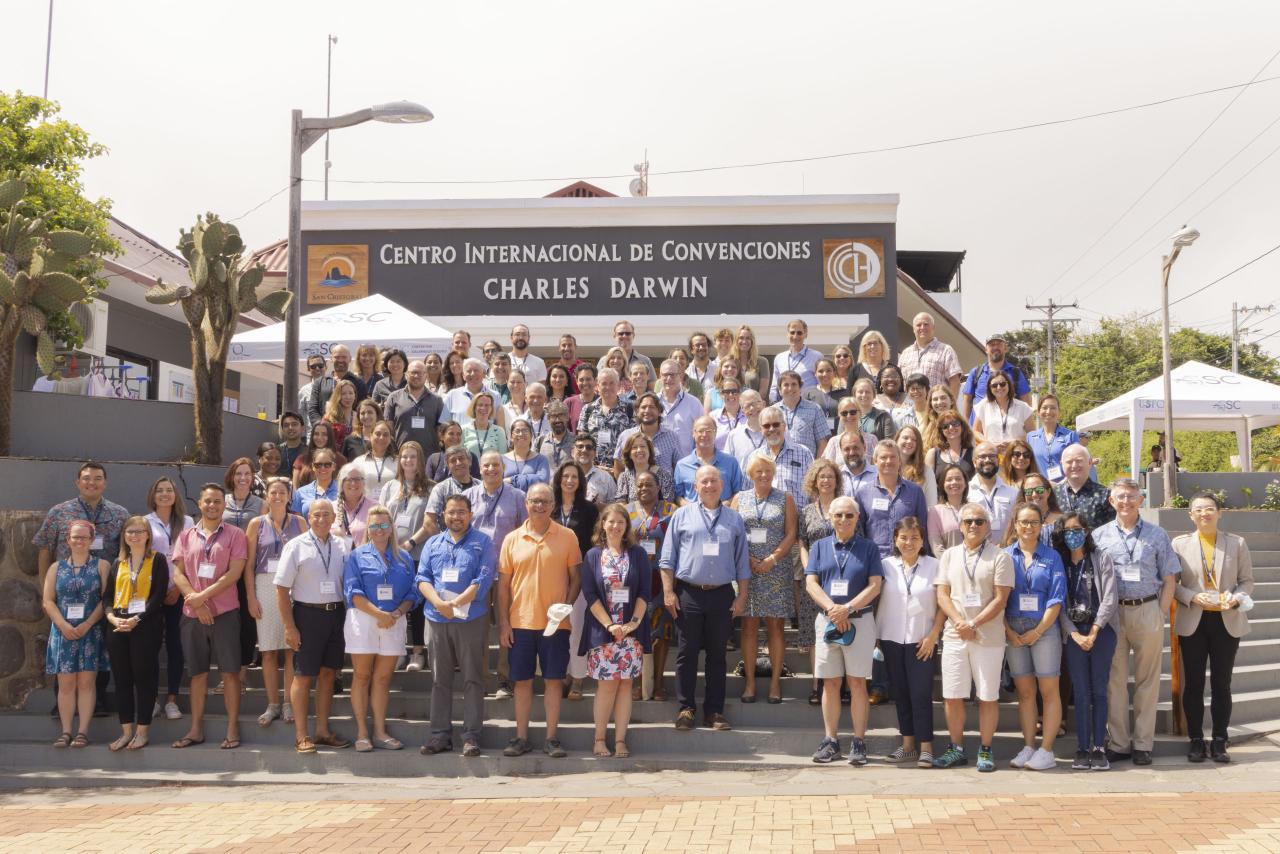
University of Guam officials shared the island’s unique sustainability story at the Global Summit on Island Sustainability in the Galápagos, considered by many to be one of the most ecologically diverse spots on planet earth.
The Summit corresponded with the 10th anniversary of the Galápagos Science Center, a multidisciplinary research consortium formed by the University of North Carolina at Chapel Hill and the University of San Francisco in Quito, Ecuador. As program hosts, the GSC wanted to elevate and highlight the Galápagos in the island conservation discourse.
UOG President Thomas Krise and UOG Center for Island Sustainability and Sea Grant director Austin Shelton presented on the Guam Green Growth Initiative. Shelton was a featured speaker and presenter on the, “Island Sustainability, Paths Forward” panel, which featured sustainability experts from around the world.
Shelton said the Summit opened potential collaborative engagements with other universities in education, research, and outreach. “We found some new technologies that will be very helpful to our movement and sustainability here. For example, there are technologies in the circular economy that we are hoping to test in our G3 Circular Economy and Makerspace and Innovation Hub.”
Renewable energy is another potential area for collaboration, according to Shelton. “The University of Edinburgh has one of the very few ocean wave generators. We hope to form a partnership where they will do more pilots in the Galápagos, French Polynesia, the Galápagos and Guam. So, we are hoping to get these things moving over the next year.”
The Summit organizers highlighted Hawaii’s and Guam’s Green Growth Program and the Global Island Partnership and their plan to examine existing global programs that emphasize island sustainability and their incorporation into life, policies, and circumstances in the Galápagos Islands.
According to the Summit organizers, they plan to publish an edited book titled “Island Ecosystems: Challenges to Sustainability,” as part of the multi-volume book series on the Galápagos Islands (Stephen J. Walsh & Carlos F. Mena, Series Editors) published by Springer Nature. The book will include the papers and presentations delivered at the Summit.
Around 150 participants from around the world attended the Summit, including Guam, Hawaii, Australia, and Chile. According to the organizers, “the Summit was an opportunity to bring together thought leaders from around the globe to interact and share best practices so we can not only help preserve the Galápagos but other similarly challenged island ecosystems around the world. ”